Plaud is a recording device with a subscription for the transcription. Across a table that works well. On phone calls there are catches: calls made with AirPods or other earbuds are not captured, you have to press the record button yourself on every call, and the device has to sit on the back of your phone. The NotePin only has a mode for conversations in the room. If you call a lot, an app that joins the line fits better. With Ajora there is no device to buy: you install an app on the phone you already have. It is a subscription too, at €19 a month.
What is the best Plaud alternative?
That depends on what you capture. For a conversation across a table Plaud itself is a good choice, and another device is mostly a matter of price. For phone calls, an app that joins the line works better than a device that has to pick the sound up from your phone.
Plaud makes recording devices. The Plaud Note and the Note Pro are the size of a bank card, the NotePin is worn on your clothes. The device records and the app turns it into a transcript and a summary. Sitting across from a client, you put it down and press the button.
A phone call is a different problem. A device is not on the line, so it has to get the sound some other way. The Plaud Note does it with a sensor that reads the vibration out of your phone’s housing. That works, but conditions come with it. They are in the next section.
If you want to compare the devices with each other, that is covered in more detail in Plaud vs Pocket vs Ajora. This article is about what to pick when Plaud does not fit.
Why do people look for an alternative to Plaud?
Mostly because of phone calls. With earbuds in, a call is not captured, you have to start every recording yourself, and the quality depends on how the device sits on your phone. On top of the device you also pay for a subscription once you transcribe more than 300 minutes a month.
Calls with AirPods or other earbuds are not captured
Plaud’s sensor reads both sides of the conversation out of your phone’s housing. If you call with AirPods, a headset or other earbuds, the sound does not pass through there. Plaud therefore does not support it, wired or wireless. If you are used to calling with earbuds in, you have to hold the phone to your ear again for every call you want captured.
You have to remember it on every call
Asked whether the Plaud Note records phone calls automatically, Plaud answers no. You attach the device to your phone and press the record button, on every call again. That is easy to forget, especially when someone calls you: you pick up, the conversation starts, and nothing is recording. What you did not record cannot be recovered afterwards.
The quality depends on how the device sits
The device picks the sound up through your phone’s speaker, so it has to be attached firmly to the back of your phone, Plaud writes in its support pages. For the Note Pro, Plaud adds two more requirements: call volume at 80 percent or higher, and a thick case off. Plaud has a support article of its own on low volume and poor sound quality on the Note Pro. If the device sits crooked or your volume is low, the recording suffers.
A device with a subscription on top
In Plaud’s European store the Note and the NotePin cost €169.90, the NotePin S €179 and the Note Pro €189. Every device comes with the free Starter plan and its 300 transcription minutes a month, which is five hours. If you need more, Pro costs €19.99 a month, or €9.20 a month billed yearly, with 1,200 minutes. Unlimited costs €34.99 a month, or €18.70 billed yearly.
The NotePin and the NotePin S are out for phone calls altogether. In Plaud’s own comparison of its devices, those two only list the mode for in-person conversations.
Is there a Plaud alternative without a device?
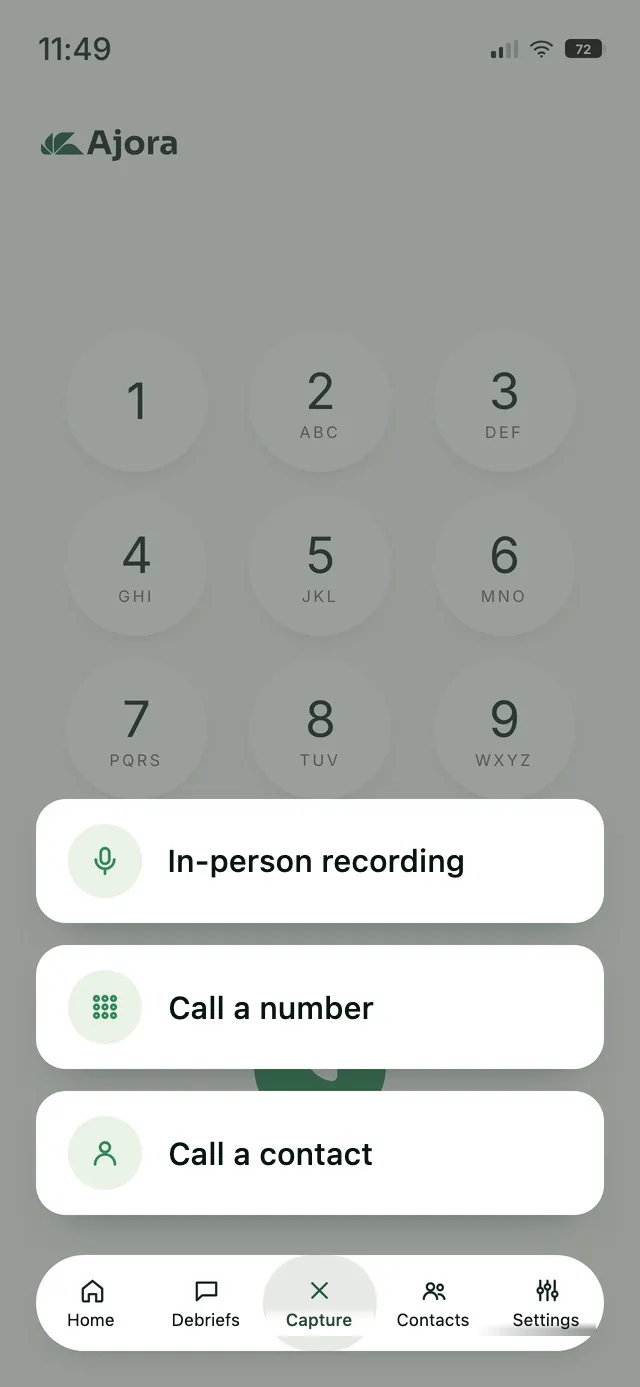
Yes. With Ajora there is no device to buy: you install an app on the phone you already have. On a phone call Ajora joins the line, and for a conversation across a table you pick Physical recording under Capture in the same app.
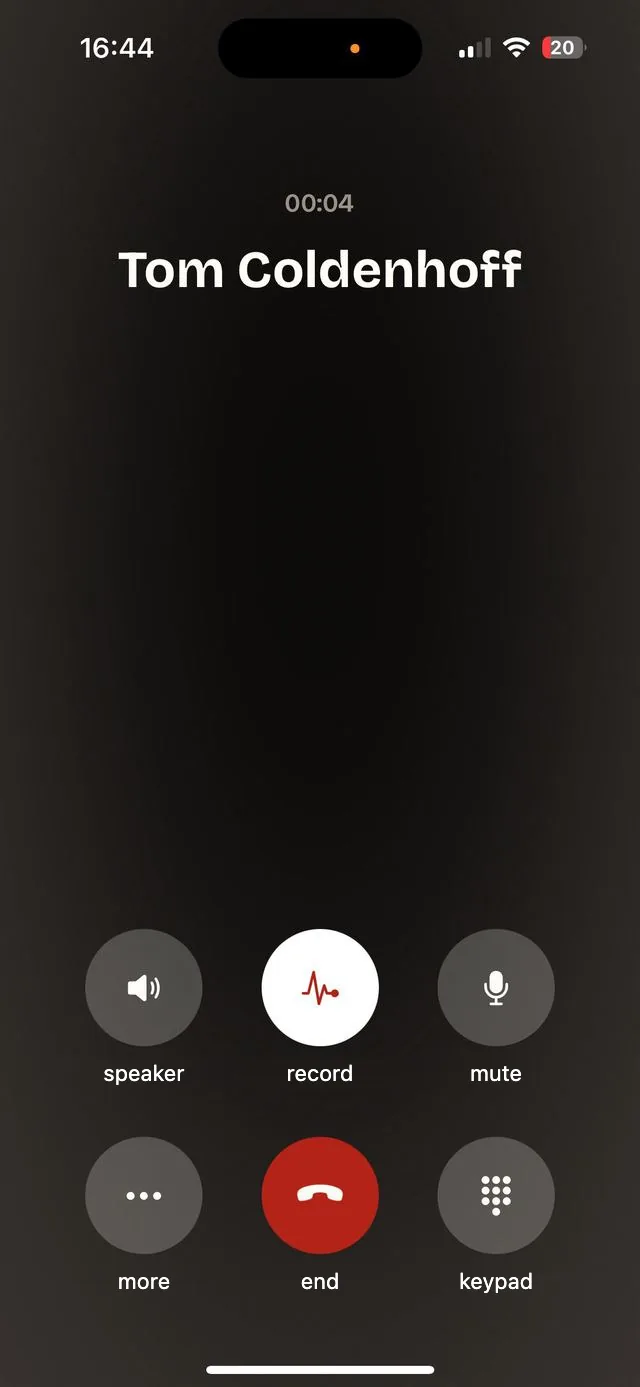
For outgoing calls you dial from the Ajora app, with your own contacts in it. For incoming calls you switch on call forwarding once, and after that a call comes along as soon as someone rings you. During the call there is nothing to operate. The call runs over the line and not through a microphone. That is why it is also captured when you have AirPods in or call hands-free in the car.
A few minutes after you hang up a debrief is waiting: a summary with the action items and the decisions, and the full transcript underneath. How to set it up is in automatically record a phone call on your iPhone. What goes into the transcription is in transcribing a phone call.
Ajora keeps no audio. You get the transcript and the summary, and the recording itself is deleted after transcription. If you want to be able to listen back to a conversation, a device like Plaud or Pocket fits better: they keep the audio file and let you download it.
Is there a Plaud alternative with no subscription?
Ajora is not it. It is a subscription too, at €19 a month or €15 a month billed yearly. There is no device to buy and 600 calling minutes a month are included in the price. If you want no subscription at all, you end up with a device on a free plan, and Plaud itself has one.
You can use Plaud without a paid subscription. The Starter plan is free and gives you 300 transcription minutes a month. If you record little, you pay nothing more after buying the device. Pocket has a free plan too, with unlimited transcription at standard accuracy and summaries that are kept for 30 days.
Ajora has no free plan. You pay by the month or by the year, and the calling is part of it: the call runs through Ajora, so the calling minutes come with the subscription. The monthly plan can be cancelled every month, and there is a money-back guarantee for fourteen days after your first payment.
If you capture a conversation across a table now and then, a device on a free plan costs you less than Ajora. If you call every day and want every call captured by itself, with Ajora you pay for something a device does not do.
Plaud Note, NotePin, Pocket or Ajora: what are the differences?
The Plaud Note and Pocket record a phone call when they are on your phone and you start the recording yourself. The NotePin is for conversations in the room only. Ajora joins the line and asks nothing of you during the call. The yearly cost and the rest of the comparison are in the table.
| Plaud Note | Plaud NotePin | Ajora | ||
|---|---|---|---|---|
| What it is | A recording device the size of a bank card. | A recording device worn on your clothes. | A card that snaps onto the back of your phone. | An app on the phone you already have. |
| Phone call | Yes, when the device is on your phone. With AirPods or other earbuds in, the call is not captured. | No. Only a mode for in-person conversations. | Yes, with a contact microphone, when the card is on your phone. | Yes. Ajora joins the line, also with AirPods or other earbuds in. |
| Automatic on a call | No, says Plaud itself. You press the button on every call. | Not applicable. | You start a recording with the side button. | Outgoing you dial from the app, incoming comes along through call forwarding. |
| Conversation across a table | Yes. Two microphones, a range of up to three metres according to Plaud. | Yes. Two microphones. | Yes. Two microphones, up to fifteen metres according to Pocket. | Yes, with your phone’s microphone, through Physical recording. |
| Cost in the first year | €169.90 on the free plan of 300 minutes a month. Around €280 with Pro billed yearly. | €169.90 on the free plan. Around €280 with Pro billed yearly. | 129 dollars on offer, normally 199, on the free plan. 368.88 dollars with Pro. | €180 billed yearly, €228 if you pay by the month. No device. |
| Cost per year after that | Nothing on the free plan. Around €110 with Pro, around €224 with Unlimited. | The same as the Note. | Nothing on the free plan. 239.88 dollars with Pro. | €180 or €228. |
| Does it understand Dutch? | Yes. Dutch is on the list of 112 languages. No two languages in the same recording. | Yes, the same app and the same list. | Pocket names more than 120 languages and does not list them on its product page. | Yes, Dutch and English among others. |
| Does it keep the audio? | Yes. Exportable as MP3 or WAV. | Yes. Exportable as MP3 or WAV. | Yes. Audio download is part of the free plan. | No. You get the transcript and the summary. |
| Where your data sits | According to the privacy policy on servers in the United States, Germany, Japan and Singapore, in the data centre that corresponds to your region. | The same privacy policy as the Note. | Processing on cloud infrastructure in the United States, according to Pocket itself. | Transcripts and summaries on servers in Germany. Transcription runs through a processor in the United States, after which the audio is deleted. |
Plaud’s prices come from its European store. Pocket’s are listed in dollars on the product page, with a note that you pay in your local currency. With a device your calling minutes keep running through your own carrier. With Ajora, 600 a month are included in the subscription.
When is Plaud the better choice?
When you mostly capture conversations in a room and want to be able to listen back to the audio. A Plaud has its own microphones and works independently of your phone. On the free plan it costs nothing after purchase, up to 300 minutes a month.
Ajora is built for the phone. For a conversation across a table, Physical recording does the job with your phone’s microphone. In a large room with several speakers a Note Pro has the edge, with four microphones and a range of up to five metres according to Plaud.
It does not have to be one or the other. If you sit across a table a lot and call a lot too, you can keep the device for the room and take an app for the line.
Frequently asked questions
Does Plaud work in Dutch?
Yes. Dutch is on the list of languages Plaud supports for transcription; Plaud names 112 of them. You pick the language yourself or let Plaud detect it. Plaud cannot currently transcribe two languages in the same recording. If you switch between Dutch and English in a conversation, Plaud advises picking the language that dominates.
Can Plaud record phone calls?
The Plaud Note and the Note Pro can, with a vibration sensor that reads the sound out of your phone. The device has to be on the back of your phone for that, and earbuds are not supported. The Plaud Note does not support automatic call recording: you press the record button on every call. The NotePin only has a mode for in-person conversations. With Ajora the call runs over the line and there is nothing to do during the call.
What does Plaud cost per year?
In the first year you pay for the device: €169.90 for the Note or the NotePin, €179 for the NotePin S and €189 for the Note Pro. On the free Starter plan of 300 minutes a month it stays at that. Pro billed yearly is €9.20 a month, so around €110 a year, for 1,200 minutes a month. Unlimited billed yearly is €18.70 a month, around €224 a year. For comparison: Ajora costs €180 a year billed yearly, with no device and with 600 calling minutes a month.
Do you need a subscription with Plaud?
Not necessarily. Plaud’s subscription is about transcription minutes. Every device comes with the free Starter plan of 300 minutes a month. Pro gives you 1,200 minutes and Unlimited is unlimited, up to 24 hours a day. Minutes you do not use do not roll over to the next month. If you record less than five hours a month, you do not need a paid subscription.
Can I take my recordings with me if I leave Plaud?
Yes. Plaud lets you export audio as MP3 or WAV, transcripts as TXT, SRT, DOCX or PDF and summaries as TXT, Markdown, DOCX or PDF, one file at a time or in bulk. According to the pricing page your recordings and transcriptions are not deleted when you cancel a paid plan; your account reverts to the Starter plan. With Ajora there is no audio to take with you, because it is not kept. Your transcripts and summaries are in the app and the dashboard, and on a paid plan you can fetch them through the API.
Is there an alternative to the Plaud Note Pro?
The Note Pro is Plaud’s model for larger rooms, with four microphones and a range of up to five metres, at €189. If that is what you are after, this comparison has no equivalent replacement: Pocket names a fifteen-metre range with two microphones, and Ajora uses your phone’s microphone. If you want an alternative because you are mostly on the phone, an app on the line such as Ajora is the more obvious choice.
Does Ajora work when someone calls me?
Yes. You switch on call forwarding once in the app, and after that an incoming call comes along without you doing anything. That works on KPN, Vodafone/Ziggo, Odido and plenty of other carriers. Where a carrier does not allow it, you add Ajora to the call by hand.
Am I allowed to record a phone call?
In the Netherlands you may record a conversation you take part in yourself. If you use it for work, you are processing personal data and the GDPR applies. That is written out in a separate piece: is it legal to record a call.
To see the devices side by side, read Plaud vs Pocket vs Ajora. If you are looking for a recording app rather than a device, that comparison is in Ajora vs TapeACall.
You can try Ajora free for seven days, with 60 calling minutes included. Create an account at debrief.ajora.io/register, install the app and call the way you always do; after your first call the debrief is waiting.
Sources
- Plaud AI plans: prices, minutes per plan and what happens when you cancelPlaud, European store, accessed 08-10-2026
- Plaud devices compared: prices, microphones, range and recording modesPlaud, European store, accessed 08-10-2026
- Plaud Note, product page with price and what is in the boxPlaud, European store, accessed 08-10-2026
- Plaud NotePin, product page with pricePlaud, European store, accessed 08-10-2026
- Plaud Note Pro, product page with price, microphones and rangePlaud, European store, accessed 08-10-2026
- Does Plaud Note support automatic call recording?Plaud Support, accessed 08-10-2026
- Can I use headphones or earphones when I record a phone call with Plaud Note?Plaud Support, accessed 08-10-2026
- Low volume or poor sound quality on Plaud Note Pro, with the requirements for placement, call volume and casePlaud Support, accessed 08-10-2026
- How many languages does Plaud support for transcription? With the full listPlaud Support, accessed 08-10-2026
- Export recordings, transcripts, and summaries, with the file formatsPlaud Support, accessed 08-10-2026
- Privacy policy, version of 16 June 2026, with the server regionsPlaud, accessed 08-10-2026
- Pocket, product page with price, plans, microphones and languagesheypocket.com, accessed 08-10-2026
- Pocket Trust, where recordings are processedheypocket.com, accessed 08-10-2026

One of the three co-founders of Ajora. Jort focuses on user experience and growth.